Slab Foundation Repair
Cracks climbing the brick, doors that stopped latching, a floor that isn't where it used to be — slab underpinning is how settlement gets stabilized.
Serving Copperas Cove, Killeen, Harker Heights, Nolanville, Gatesville, Lampasas
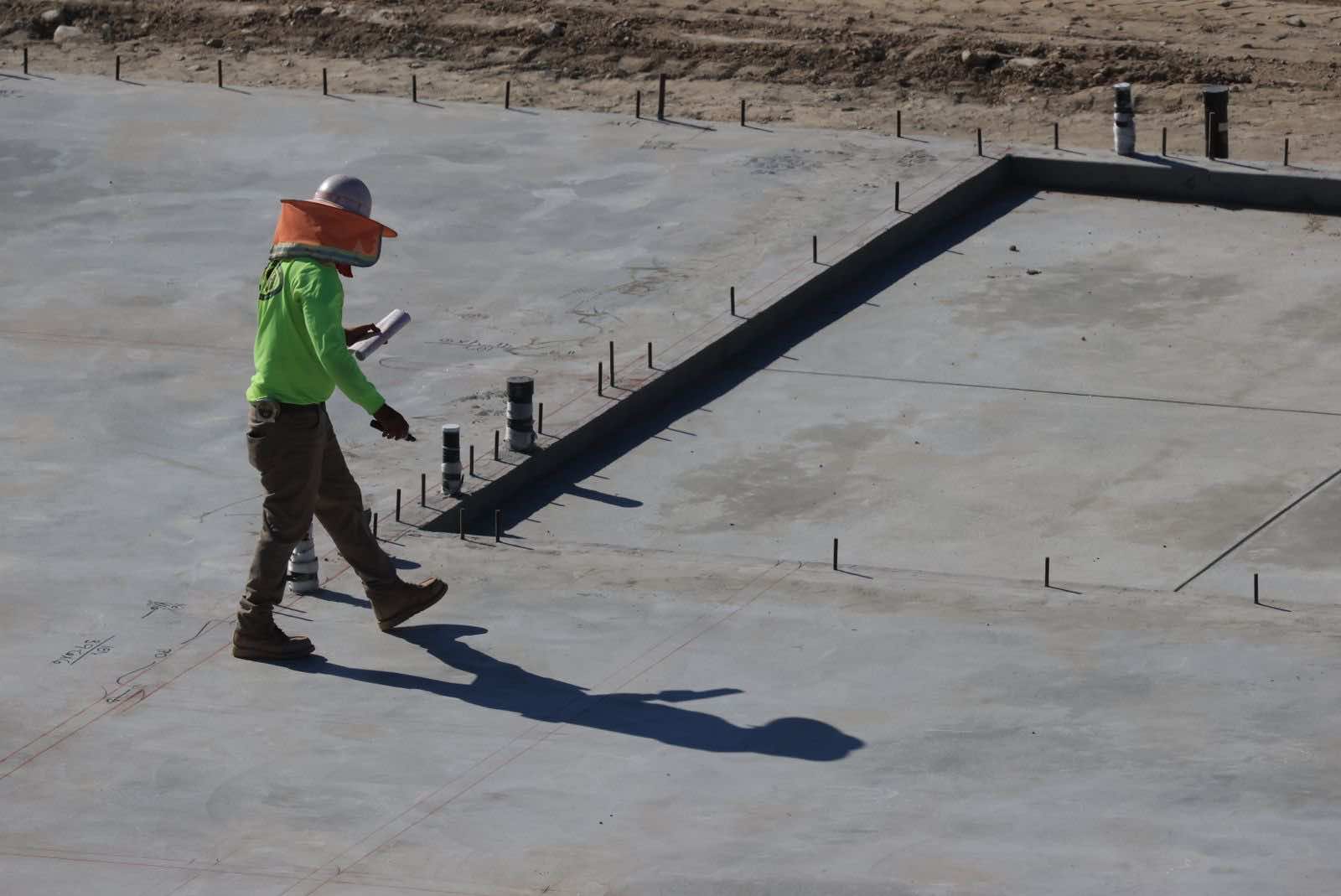
Nearly every home in Copperas Cove, Killeen, and Harker Heights sits on a slab-on-grade foundation. When part of that slab settles and the rest doesn't, the difference shows up above ground: stair-step cracks in the mortar joints, diagonal cracks from door and window corners, gaps at the baseboards, and doors that suddenly bind in their frames.
The standard fix is underpinning — transferring the load of the settled section onto pilings driven down to a firmer bearing stratum, then lifting that section back toward its original elevation and shimming it in place. In Texas the highest-volume method is the pressed concrete piling: precast cylinders hydraulically driven under the grade beam one at a time, using the weight of the house itself as the reaction mass, until they meet refusal.
Two things are worth knowing before anyone gives you a number. Underpinning only helps the part of the house that gets underpinned — the Texas Section ASCE guidelines require construction documents to say so explicitly. And no repair returns a foundation to laser-flat; those same guidelines state plainly that perfection is not attainable by remedial measures. The realistic goal is stabilization and acceptable performance, not a level floor.
Common requests
- Stair-step cracking in brick or block mortar joints
- Diagonal drywall cracks radiating from door and window corners
- Interior doors that stick, drag, or won't latch
- Gaps opening between baseboard and floor, or wall and ceiling
- A perimeter section that has visibly dropped relative to the rest
- Slab movement flagged during a home inspection or sale
Signs it's time
- Brick veneer separating from window frames or the slab line
- Cracks that have measurably widened over a single season
- Floors sloped enough to notice while walking across a room
- Exterior trim, fascia, or soffit pulling apart at the corners
- A door above a wall crack that stopped closing — correlated symptoms matter far more than any single crack
Good to know
- Pricing is driven by pier count and depth, not square footage. Published Texas ranges run roughly $450–$900 per pressed concrete piling and $8,000–$25,000 for a typical piering job — those are third-party ranges from larger Texas metros, not quotes for your home.
- Perimeter-only work is far cheaper than interior piers. Interior piers require cutting through your floors, which means moving out for a few days and replacing floor covering.
- Insist on plumbing testing after any lift. Rigid cast iron and PVC under a slab do not enjoy being raised; ASCE guidance calls for testing supply and drain lines whenever jacking is part of the repair. A contract that omits it is incomplete.
- In Killeen, foundation repair has required a permit since March 1, 2022 (Ordinance #22-004), and both compliance paths involve a licensed engineer. Budget for that from the start.
- Read the warranty document, not the warranty headline. Most cover only the pilings installed, only in the area worked, and only past a stated movement threshold.
Slab Foundation Repair — frequently asked questions
How much does slab foundation repair cost?
Published Texas ranges are roughly $450–$900 per pressed concrete piling, with whole jobs commonly $8,000–$25,000 depending on pier count, depth, and whether interior piers are needed. Those figures come from third-party cost surveys in larger Texas metros — the Killeen–Copperas Cove market has no neutral published dataset. Only an on-site assessment produces a real number.
How deep do the pilings go?
Until refusal — the depth at which the soil or rock stops accepting further advance, typically around 18–20 tons of resistance. In this area that can be quite shallow, because limestone and caliche sit close to the surface across much of Coryell and western Bell County. Shallow refusal on a rock ledge is not always the same thing as reaching a competent bearing stratum, which is one good reason to have an engineer involved rather than buying from a per-pier price sheet.
Will my house be level when it's done?
No, and you should be skeptical of anyone who promises it. The Texas Section ASCE guidelines state that elevation adjustments are unlikely to result in a level foundation and that perfection is not attainable by remedial measures. The goal is to stabilize movement and recover enough elevation that doors work and cracks close — not to produce a flat floor.
Do I have to move out during the work?
Usually not. The large majority of jobs are perimeter-only — noisy and hard on your landscaping, but livable. Interior piers are the exception: those require cutting roughly 2'×2' access holes through your floors, and most people leave for that portion.
Will fixing one side fix the whole house?
No. Underpinning improves the performance of the underpinned area only — ASCE guidance requires that to be stated in the construction documents. If the other side of the house later moves, that is new work at full price, not a warranty claim.
Get an estimate for slab foundation repair
Describe what you're seeing, attach photos if you have them, and get a clear next step — with no obligation.